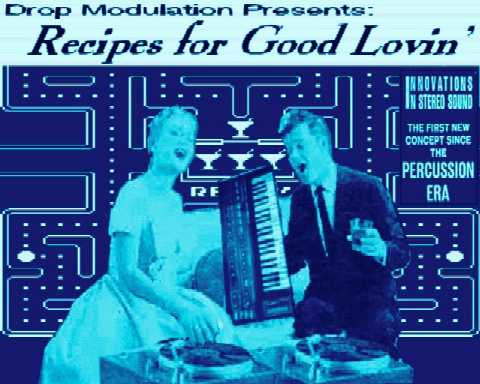
The one remaining copy of the out-of-print 1962 classic.
Fame was not to be had in the polka movement, so it was a happy coincidence that, after relocating to swinging Hoboken, New Jersey, the hep cats of Drop Modulation ran adrift of the swelling Jersey lounge sound. Here was another subculture that could be appropriated, One that offered even more opportunities for getting plastered than their polka roots, and with classier drinks. DM quickly got the hang of things, but it was hard to run a swanky hi-fi bachelor pad while living with senile highway maintenance men, a leper colony, and William S. Burroughs. The DM lads had met a young and dashing Richard Nixon at a very private party they had crashed. Sympathetic to their situation, he was able to obtain them a record contract with the prestigious Monodor Recording company, who had released such big sellers as Teach Your Poodle to Speak the Easy Way, and Paul Anka's festive work, Arbor Day in Thailand. The first album Recipes for Good Lovin' featured the innovation of containing a seperate record for each stereo channel. Unfortunately this required two turntables and perfect timing, something that the general public was not yet ready for. Sales were slow, and the huge milk carton ad blitz used to promote the album soon rendered Monodor bankrupt.
Despondent, Tim and John moved to San Francisco in 1966, where they drowned their sorrows in the sights and sounds of the early psychedelic movement. Drop Modulation hold the honor of being the only two people acid guru Timothy Leary felt should never use drugs. Eventually, DM began recording with an exciting new sound that spawned underground classics like "Mauve Fog," and "I am the Harbour Seal," believed by many critics to be influential on Jimi Hendrix and The Beatles, respectively. Invited to play the Woodstock Music Festival, Tim's intense fear of naked hippies forced DM to turn back and head home.
Drop Modulation worked steadily through the 1970's, building a cult following and pioneering a unique prog rock sound featuring 7/19 time signatures, 12 minute electric glockenspiel solos and gongs, gongs, gongs. The media spotlight shone on Drop Modulation for a year in 1974, as they slowly lost a long, public court battle over the rights to "the Oscar Meyer Weiner Song," which they claimed was a note for note plagiarism of a staple of their live sets, "I wish I were a Fletcher's All-Beef Ballpark Frank." Tragedy struck again in 1977, when while opening for Pink Floyd at Wembley Stadium, a huge pyrotechnic display set ablaze the world's largest inflatable penguin. It was time for a rest.
John moved to Argentina, where his attempts to assemble his Funk Banjo Disco Allstars were foiled by his inability to speak Spanish. Tim moved to Jamaica, where he converted to Rastafarianism and was mocked incessantly by the locals.
Finally, in 1992, in the port city of Vancouver, British Columbia, Tom Szymanski and Jovian Francey, founded Euphonix, which became Euphonics, which became Urban Shade, before they finally decided to rip off the Drop Modulation name in 1997. While they occasionally adjust their knobs for the public in a live environment at various parties or as known in the media parlance, "raves", they are more often drinking coffee while sequestered in a bedroom studio. They are of no relation to Tim Shim or John Fancy, but together they keep the name, the legacy and the music alive.